Cut, Peel, Shred: The Grip Tape Artists Who Work for Oblivion
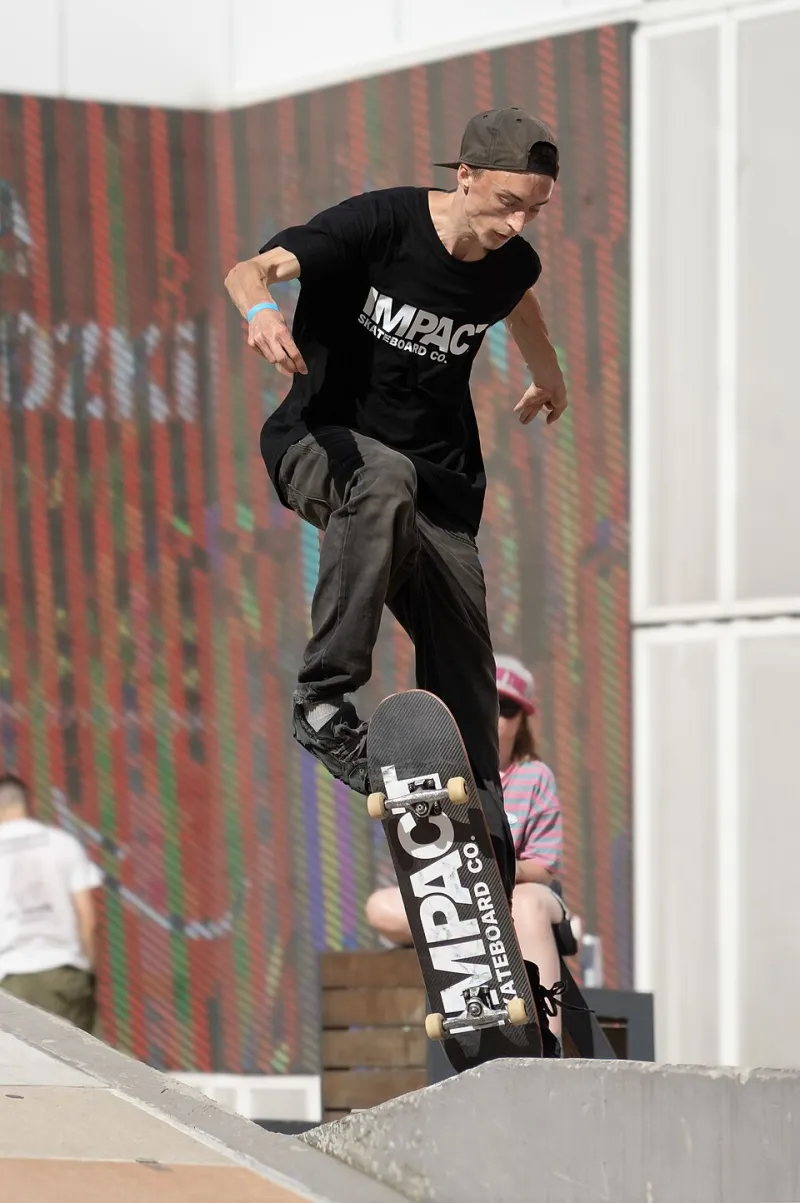
Photo: Krzysztof Popławski, CC BY 4.0, via Wikimedia Commons
You can drop $70 on a deck, $60 on trucks, $55 on wheels, and another $60 on shoes, and the part of the setup that touches you most is a $12 sheet of 80-grit that comes in black, black, or black. Grip tape is the skateboard's least photographed surface. It is also, for a certain kind of rider, the only surface that matters.
The Last Blank Square Inch
A deck graphic gets shot before it ever gets skated. The grip gets a photo maybe once, on the day it's applied, in a garage, under a fluorescent bulb, and then it vanishes under a shoe. That window is the whole game for the people who treat grip as a canvas. They cut stencils at kitchen tables, spray adhesive in backyards, and press paint through the perforations of a sheet that will be chewed to gray in a month. The work is meant to be destroyed. That's the point.
The Shop-Rat Apprenticeship
Walk into a skater-owned shop in Portland, Oregon, on a slow Tuesday and you might find a 27-year-old named Marcus with an X-Acto knife, a roll of stencil film, and a look of total concentration. He's been cutting grip art since he was 14, when a friend showed him how to trace a logo onto contact paper and blast it with spray paint. Now he does it for customers who ask nicely and for friends who bring him a six-pack of something cheap.
'It's the only art you make that you know is going to get ruined,' Marcus says. 'That takes the pressure off. You're not framing it. You're not selling it. You're just making something that'll be gone by the end of the season.'
The tools are basic: a fresh blade, stencil film, spray adhesive, acrylic paint pens, and a roll of grip. The skill is in the negative space, knowing what will read clearly when the sheet is pressed onto a deck and then covered by a moving shoe. A clean stencil of a skull is easy. A stencil that survives the first week of slappies and still looks intentional is harder.
The Copying Question
Grip art has an ethics problem, and everybody who does it knows the word for it: biting. Copying a friend's tape job is different from copying a pro's. The pro's tape is a public image, fair game for homage. The friend's tape is personal property, and an exact replica is the kind of thing that starts a quiet feud in a group chat.
The code is loose but real. If you see a tape job you love, ask. If you remake it, change one thing. If you post a photo, credit the person who cut it. Never copy a local's signature, especially if that local is a 16-year-old in Columbus, Ohio, who spends study hall sketching stencils in a notebook and has exactly one thing that's theirs.
'There's a difference between inspiration and theft,' says a San Diego artist who goes by the handle TapeJob. 'If you take the layout and flip it, that's a conversation. If you take the exact layout and post it like you made it, that's just lazy.'
Designed to Disappear
The best grip art isn't the loudest. It's the kind that reveals itself slowly. A layered stencil, where a second image sits under the first and appears as the top layer wears away. A negative-space cut that leaves a clean black field and a shape that only makes sense from the top down. Paint under the grip, so the color blooms through the perforations after a few weeks of skating.
One artist in San Diego paints a solid color layer under a black top layer. After two weeks of riding, the black wears through at the high-traffic points and the color starts to show. 'The board finishes the piece,' he says. 'I just start it.'
That's the difference between grip art and a deck graphic. The deck graphic is finished when it's printed. The grip art is finished when it's destroyed. The gallery is the parking lot. The photo is the wear pattern. The audience is whoever happens to be standing behind you at the spot when you flip your board up to walk away.
What Gets Left Under the Shoe
Grip tape is a consumable. It's supposed to get shredded. But the people who cut it, paint it, and press it onto a board are doing something that the rest of the setup doesn't allow: they're making a personal mark on a machine that's designed to be replaced. The deck snaps. The wheels flat-spot. The shoes blow out. The grip just fades, slowly, into a gray smear that used to be a skull or a name or a joke.
Maybe that's why it stays underground. The best grip art never gets a photo shoot. It gets a month of skating, a few scrapes, and a quiet retirement in the garage. And that's exactly how it should be.