Nine-Tenths of a Second: The Neuroscience of Landing Your First Flip
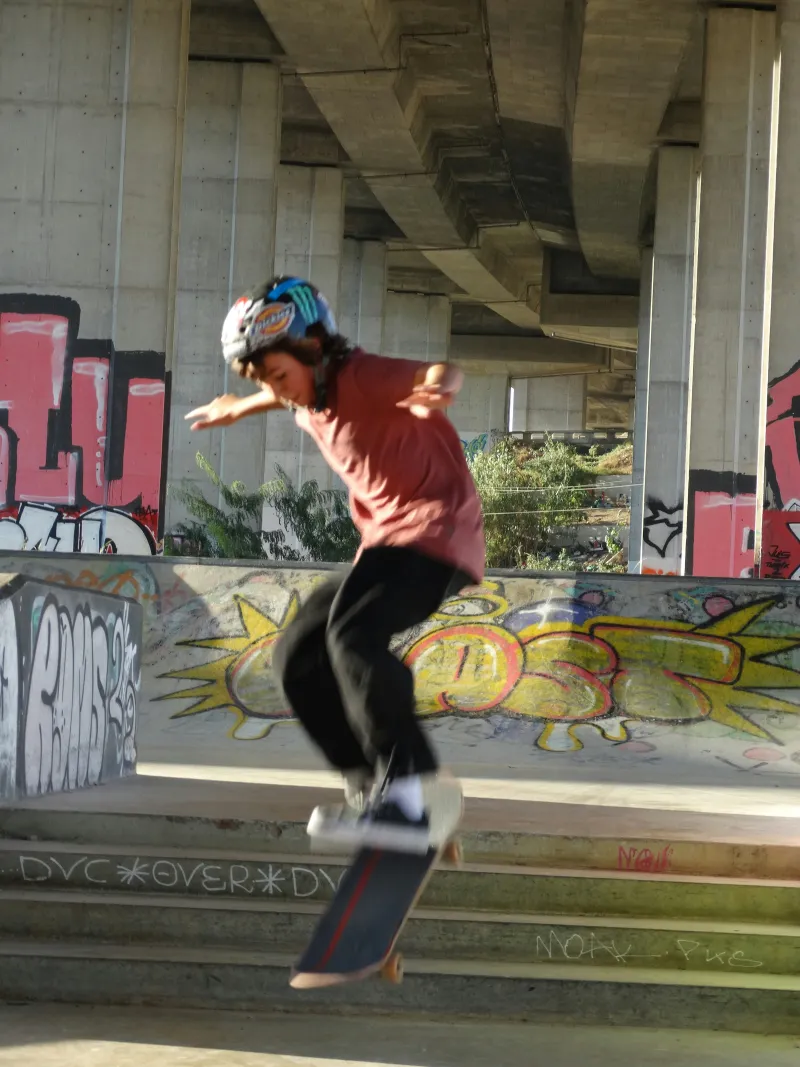
Photo: teenage skateboarder mid kickflip concrete skatepark, via images.unsplash.com
There's a moment in every skater's life that lasts about 0.9 seconds. The pop. The flick. The board spinning beneath you like something you don't own yet. Then either you roll away or you don't.
Here's the thing nobody tells you: it doesn't actually matter which one happens. The rewiring starts the moment you commit.
The Physics Is Easy. The Brain Is Not.
A kickflip is, mechanically speaking, nothing. You're popping an ollie, dragging your front foot off the edge, and letting the deck spin 360 degrees on its long axis. Any physics student can diagram it. What the diagram won't show you is the part where your brain has to convince your body to jump at a board that's actively betraying you.
Dr. Ellen Marchetti, a sports psychologist who works with action-sports athletes out of Denver, puts it bluntly: "The kickflip is a fear-calibration exercise disguised as a trick. Your amygdala is screaming that the board is a hazard. Your prefrontal cortex has to override it in real time. Every attempt is a rep for that override system."
That override system — the one that says jump anyway — doesn't stay in the skatepark. It follows you to the SATs, the breakup, the job interview, the phone call you've been putting off for three weeks.
Failure at 400 Attempts Per Trick
Think about the math. The average skater attempts a kickflip somewhere between 200 and 600 times before landing it consistently. That's hundreds of explicit, physical failures in a two-week span — failures that hurt, that leave scabs, that happen in front of people.
And here's the wild part: nobody quits. Or at least, far fewer people quit than the failure rate would predict.
"Compare that to a math class," says Marcus Bell, who coaches at a youth program in Columbus, Ohio. "A kid fails one test and decides he's 'bad at math' for life. Same kid eats pavement 300 times learning a flip trick and comes back the next day. The difference is that skateboarding gives you feedback you can feel and progress you can see. School hands you a letter grade and calls it a day."
Bell has watched kids who were labeled difficult or unfocused in school turn into the most patient, methodical people at the park. The trick didn't just teach them to skate. It taught them that failure is data, not identity.
The Trick That Got Them Through It
Ask around any skatepark long enough and you'll hear versions of the same story. The trick wasn't just a trick.
There's Jesse, 19, from Phoenix, who learned his first kickflip the summer his parents divorced. "I couldn't control anything happening at home. But I could stand on this flat patch of concrete for four hours a day and control exactly one thing. When I finally landed it, I remember thinking — okay. Something in my life works."
There's Priya, a college junior in Ann Arbor, who credits her kickflip — landed during finals week of freshman year, on the loading dock behind her dorm — with teaching her how to study. "I stopped treating organic chemistry like a verdict and started treating it like attempts. You fall, you adjust your foot placement, you go again. That's literally just kickflips."
Marchetti isn't surprised. "Mastery experiences are one of the strongest predictors of self-efficacy we have in the literature," she says. "And a kickflip is a perfect mastery experience — hard enough to mean something, achievable enough to actually reach. When a teenager lands one, they're not just landing a trick. They're collecting evidence about who they are under pressure."
The Roll-Away Feeling
Riders have their own word for it. The roll-away. The moment the board stops spinning, catches your feet, and suddenly you and the deck are moving as one unit down the pavement and the whole thing is behind you.
It's 0.9 seconds of air. But the feeling afterward — that's the part that compounds. Ask any skater about their first one and watch them light up like they're describing a first love. Because in a weird way, they are. It's the first time a lot of kids learn that fear is negotiable.
And once you learn that? You spend the rest of your life looking for the next thing worth committing to. Bigger gap, harder class, scarier conversation. The board was just the practice run.
Worth the Scabs
There's a reason skateboarding keeps producing adults who are weirdly good at failing. We got our reps in early — hundreds of them, on hot pavement, in front of strangers, with nothing but a seven-ply deck and stubbornness.
So if you're a parent wondering why your kid keeps slamming on that ugly ledge behind the grocery store, or a teenager wondering if it's worth the scabs: it is. You're not learning a trick.
You're learning that you're the kind of person who tries 400 times.
That knowledge doesn't wear out. It doesn't get repossessed. It rolls away with you, every single time.