Thank God for Ugly Parking Lots: A Love Letter to America's Worst Architecture
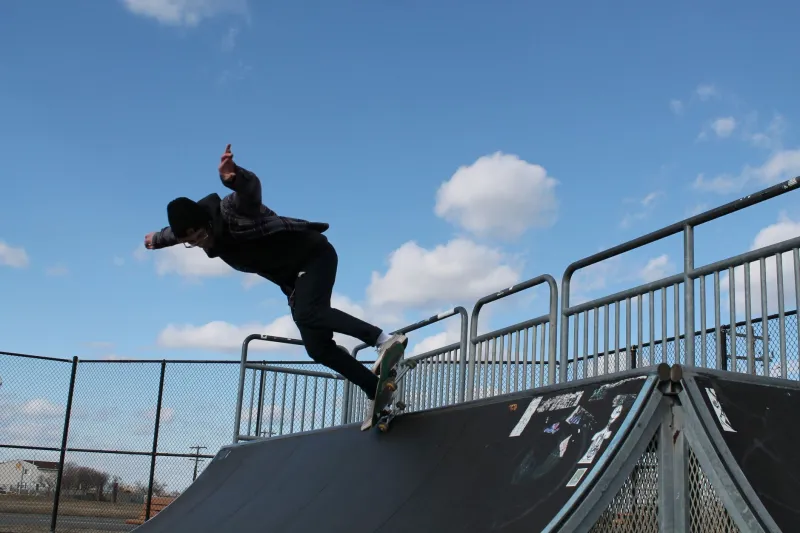
Let's get the hot take out of the way: the most important skatepark in American history has no name, no plaque, and no funding. It's the back entrance of a dying office park in Ohio, and it's perfect.
We spend a lot of ink celebrating concrete skateparks — and yeah, we've covered the great ones here before. But the honest, uncomfortable truth is that street skating was born in the architectural equivalent of a beige waiting room. Strip malls. Schoolyards. Bank plazas. The boring, bloated, car-choked landscape that urbanists love to dunk on is, functionally, an endless skatepark that some sad architecture firm never intended to build.
The Ledge Industrial Complex
Consider the humble parking lot. Roughly eight empty parking spaces for every car in America, according to basically every study on the subject. That's not just wasted land — that's flat ground. Miles of it. Smooth, lit, empty by 7 p.m., and guarded by exactly one bored security guard who leaves at 9.
Then there's the handrail. No architect has ever designed a handrail thinking, "this will be skated." They designed it for one 70-year-old with a walker, and instead created the most coveted object in street skating. Six stairs, eight stairs, the flat-bar-down-the-rail at a community college that three different video parts made famous. None of it was for us. All of it is ours.
The waxed ledge outside a Chase branch. The mellow manual pad behind a mattress store. The ditch that drains a subdivision's storm runoff and happens to have perfect transition on one bank. Suburban America built a skatepark so vast and unintentional that we haven't even finished discovering all of it.
Reclamation Without Permission
Here's what I actually love about this: skaters are maybe the only group in America that looked at the ugliest built environment in human history and found joy in it — without asking, without paying, and without changing a single thing about it.
That's a genuinely radical relationship with public space. Most people move through a strip mall parking lot trying to leave it as fast as possible. A skater reads it: the cracks, the drainage, the lighting, the angle of the curb cut. Same physical space, completely different reality. One person's dead zone is another person's spot.
And you don't own it. That's the deal. You borrow it, you sweep the glass off the ledge, you leave before the guard gets his flashlight out, and you pass it on. Every generation of skaters rediscovers the same infrastructure with fresh eyes. The plaza that was blown out in 2003 is a crew's secret spot again in 2025.
The Part Where Someone Calls the Cops
Now, the counterargument: it's private property, skateboarding causes damage, yada yada. And sure — grinding a handrail to bare steel in front of a dentist's office is technically vandalism, and nobody's arguing a 12-year-old should be doing kickflips through a farmer's market.
But let's be honest about scale. The vast majority of street skating damages nothing. A little wax on a ledge. Scuff marks. Meanwhile, that same parking lot sat empty for 14 hours a day, generating nothing, harming nothing, meaning nothing, until four kids showed up with a film camera.
Cities have figured this out, slowly. Some now build "skateable plazas" on purpose — and they're usually the best public spaces in town, packed with everyone from toddlers on scooters to 35-year-olds on lunch break. Turns out when you design space for play instead of just parking, people use it. Revolutionary stuff.
Read the Architecture
So here's my pitch: next time you're rolling through some soul-crushing American suburb, look again. That beige office park isn't a failure of imagination — it's an unfinished skatepark waiting for a crew with a push broom and a portable speaker.
America's most hated architecture gave us the most democratic playground in the country. No membership, no lift ticket, no gate. Just ledges, rails, and the audacity to treat a mattress store's back lot like it matters.
Because to us, it does.