After Hours, All Grind: The Underground World of 2 A.M. Skate Sessions
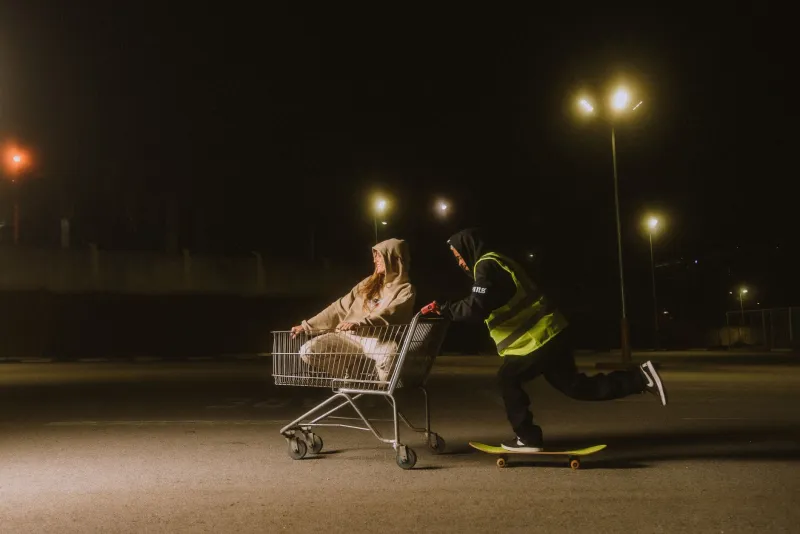
There's a sound you learn to listen for when you ride at night. It's not the pop of a tail or the grind of trucks on a ledge. It's footsteps. Or worse — a golf cart engine idling somewhere behind the gym.
If you know, you know. And if you know, you've probably been part of what the night crew calls a "sesh with the lights out": the after-hours session that starts the exact moment the last security guard locks the gate and ends when somebody's mom texts "where are you."
This isn't some rebellious manifesto. Nobody out here thinks they're changing the world. They just want to skate the one ledge in town that's actually skateable, and the only window is between midnight and whenever the sun makes them visible again.
The Lot Is the Law
Ask any night rider where the magic happens and they'll rattle off the same holy trinity: church parking lots, elementary schoolyards, and drainage ditches. Church lots are the crown jewel — huge, smooth, completely empty six nights a week, and blessedly free of the security cameras that plague downtown plazas.
There's an irony there nobody says out loud. Half the crew got confirmed in that church. Now they're kickflipping over the same parking stops where their aunt parks the minivan every Sunday.
Schoolyards run second. The blacktop is butter, the basketball hoops make perfect slalom markers, and the benches — those low, steel-framed monuments to recess — were practically designed to be boardslid. The ditch is the wildcard. Every town's got one, and every town's got three or four locals who've memorized every crack in the transition.
The Guard Who Becomes a Legend
Here's the part nobody writes about: the night scene runs on a handful of security guards who've decided this isn't their fight.
Every crew has a story about one. In a suburb outside Sacramento, the crew swears a guard named Denny used to wave them in through the side gate — then do a lap in his cart ten minutes later so the cameras showed him doing his job. In Ohio, a night watcher at a business park would leave the loading dock light on for the crew, allegedly because his nephew skated. Nobody's verified that. Nobody wants to.
These guards aren't heroes and the skaters don't treat them like saints. It's simpler than that. It's a guy with a flashlight and a mortgage deciding that kids doing kickturns at 1 a.m. rank somewhere below actual crime. Respect flows both ways: you keep it quiet, you pick up your trash, and you never, ever make him look bad to his supervisor.
Break that deal and you're not just banned from the lot. You're banned from the network. And the network is how every night crew in America operates.
The Unwritten Rulebook
Nobody hands you a laminated card. You learn the rules by breaking one and getting the look.
Lights low, voices lower. Headlamps get taped over to diffuse the beam. Yelling is for daytime. The night session runs on hand signals and the universal hiss of "guy!"
Nobody skates alone. Not for safety-in-numbers politics — for the lookout. Someone's always posted at the corner where the patrol cars roll through.
You fix what you wax. A candle stub dragged across a curb is a courtesy. A crack from a broken bottle or a scattered pile of wax shavings is a calling card for the property manager to install cameras.
New faces don't pick the spot. You get invited to the ditch. You don't bring people to the ditch. That's how a good spot dies in one weekend.
The session ends when the first light comes on. Not when someone gets hurt. Not when the trick lands. Lights on, boards up, gone in ninety seconds. Every crew drills it like a fire escape.
Gear Hacks From the Dark Side
Riding at night is a gear problem, and the solutions are beautifully low-budget.
The headlamp is the obvious move, but the veterans modify them — a strip of packing tape over the lens turns a blinding spotlight into a soft pool of light you can point at your feet without announcing your position to the whole ZIP code. Reflective tape, the kind sold for bike frames at any hardware store, gets stuck on the underside of decks and the heels of shoes so crew members can spot each other across a dark lot.
The real heads run glow-in-the-dark grip tape accents or paint a dot of reflective nail polish on the board's nose — cheap, invisible by day, and it means you never grab the wrong deck in a pile of seven boards that all look identical at midnight.
Wheels matter more than anyone admits. Softer wheels are quieter on rough blacktop, and quiet is currency. A loud setup at 1 a.m. isn't a personality, it's a liability.
Why the Dark Keeps the Culture Alive
The easy read is that night sessions exist because skaters got pushed out of everywhere else. That's true, but it's incomplete.
Something else happens after midnight that doesn't happen at noon. The lot is empty. There's no audience, no ego, no one filming for views. Tricks get tried that wouldn't get tried in daylight, in front of people. Kids who freeze up at a busy park on a Saturday afternoon will spend three hours in the dark learning the same trick, because nobody's watching.
The night crew isn't running from anything. They found the one version of skateboarding that's still just skateboarding — no crowd, no content, no pressure. Just concrete, a taped-over headlamp, and the sound of urethane on empty asphalt at an hour when the whole town belongs to you.
Then the light clicks on, and everybody scatters. Same time tomorrow.