Smell the Squall: The Lost Art of Reading the Sky From a Skateboard

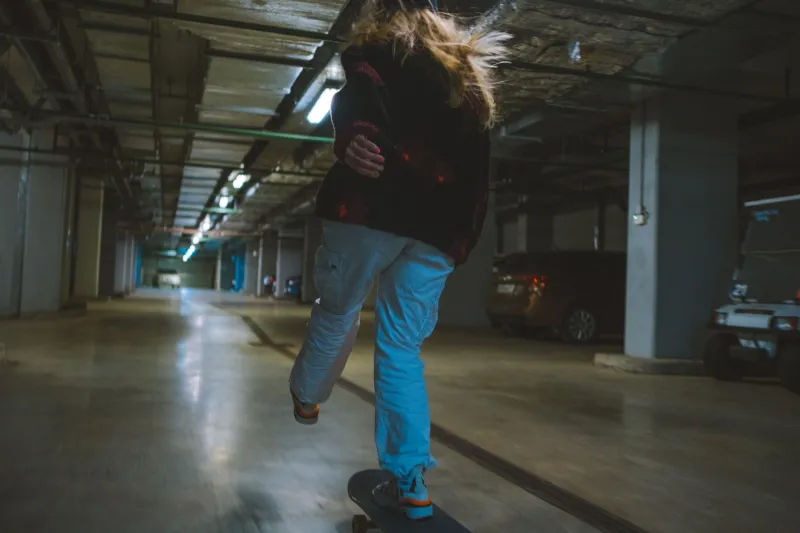
Photo: Brooke Cagle brookecagle, CC0, via Wikimedia Commons
There's a moment every rider knows. You're standing in the lot, board under your arm, and the app on your phone says 10% chance of precipitation. But the air smells like pennies and wet concrete, and the flag at the hardware store across the street just died completely. You've got maybe forty minutes.
The Weather Channel doesn't skate. It doesn't know that the plaza drains left to right, or that the wind coming over the ridge means the snow on the east faces will be chalk until noon. It knows pixels. You know the spot.
The Nose Knows First
Ask any lifer and they'll tell you the same thing: you smell rain before you see it. Petrichor — that earthy, mineral stink when moisture hits dry pavement — is the official early warning system of street skating. If the ledge starts throwing that smell at you while the sky's still blue, pack the fisheye.
"I can smell a storm coming maybe twenty minutes before it shows," says Danny Okafor, a skater from Tempe who's logged more sunset sessions than he can count. "The app has never once beat my nose. Never."
Up on the mountain, it's different but the same. Old-timers talk about a "snow smell" — a flat, cold, almost metallic stillness that settles in before a squall. Ski patrollers call it the same thing. When the air goes quiet and thick, the fog roll on the summit isn't far behind.
The Puddle Index
Every skatepark has one. The low spot, the kicker puddle, the shallow lake that forms over the quarter pipe flat bottom after every sprinkle. Locals don't check the forecast to know if the park is rideable — they check the puddle.
A big puddle doesn't necessarily mean wet ground. It means the water hasn't drained yet, which means the concrete below it is still soaked. But here's the folk knowledge part: a small puddle with dry edges usually means the rest of the park is already tacky-dry and pushing for a session. The puddle is a gauge, not a verdict.
Same logic on snow. Riders read the trees — if snow is still sitting on the branches, the pack underneath hasn't cycled through melt and freeze. If the branches are bare and the snow looks like cottage cheese, you're skiing on coral. The mountain tells you everything if you bother to look up.
Microclimates: Your Home-Turf PhD
Nobody studies for this. You just accrue it, season after season, like grip tape residue on your jeans.
- The coastal kid knows the marine layer burns off by eleven, and that the morning session is for wetsuits of the concrete variety — hoodies and cold bearings.
- The desert rider knows that a 20% rain chance in the mountains means the flats stay bone dry, and that flash flood season turns the drainage ditch behind the school into a half-pipe of death.
- The Midwest snowrider knows lake-effect bands move like train cars — you can watch one coming across the water and time your drive to meet it at the hill.
- The Northeast park rat knows freeze-thaw means the morning is a ice rink and 2 p.m. is the only window, so the session has a hard stop whether you landed the trick or not.
This is microclimate knowledge, and it's more accurate than any county-level forecast because it's based on ten thousand hours of looking at one specific hill, lot, or park.
When the Instinct Saves — and When It Sinks
Most of the time, the folk wisdom wins. Riders duck under the overpass ninety seconds before the sky opens. Snowboarders bail off the ridge twenty minutes before the whiteout. The puddle-reading saves your bearings and your dignity.
But let's be honest about the failures, too.
The same confidence that reads a squall correctly can also talk you into "one more run" as the light flattens on a wind-loaded slope. Every backcountry accident report has a version of this: the rider who trusted their gut over the avy forecast because their gut "knows this mountain." Gut knowledge is real, but it's not a replacement for the avalanche bulletin — it's a supplement.
And every skater has eaten it on a spot that "looked dry." Damp flat ground doesn't look any different from dry flat ground until your wheels decide for you. The only foolproof test is the hand-drag — palm flat on the concrete for five full seconds. If your hand comes up cool and damp, the session is dead. No app required, but no shortcuts either.
Build Your Own Barometer
Want to level up your homegrown forecasting? Start paying attention like your session depends on it, because it does.
- Learn your spot's drainage. Sketch a mental map of where water pools and where it vanishes first. That map is your go/no-go checklist.
- Watch the wind, not the clouds. Wind shifts precede weather changes by a wider margin than cloud cover. When the wind stops dead at a skatepark, something's coming.
- Note the hour the dew burns off. Every local spot has a consistent one. It's the same most of the season. Learn it once, use it forever.
- Keep a session log. Time, sky, wind, temp, how the concrete or snow rode. After one season you'll have a better forecast model for your park than NOAA has for your county.
The apps will get better. The radar will get sharper. But none of it will ever know that the flat bank dries ten minutes before the ledge, or that the wind out of the southwest means the park stays grippy till dark. That knowledge lives in your legs and your lungs and your calloused palm.
So the next time your phone says 10% and your gut says go home — trust the gut. It's been training longer.