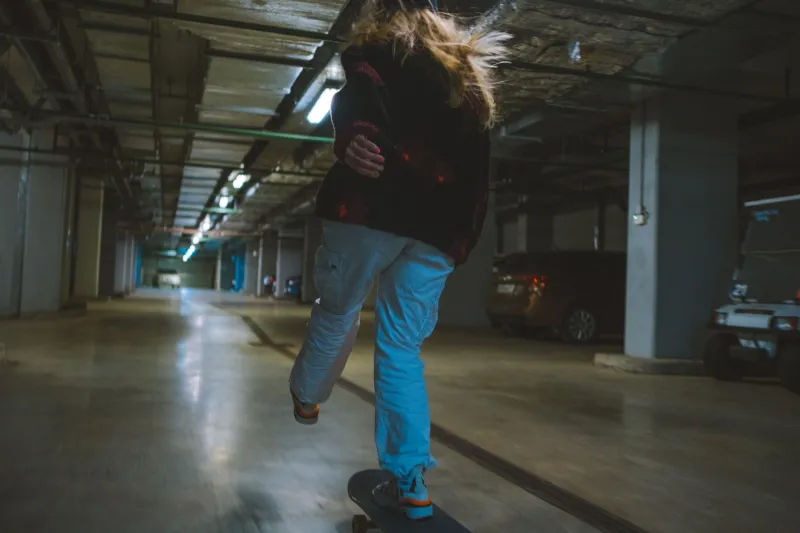
Poured for the People, Fenced for the Condos: Who Owns the Ledge Now?

Photo by Photo by KC Shum on Unsplash on Unsplash
The Best Ledge in Austin Died on a Tuesday
Nobody put up a notice. There was no community meeting, no Change.org petition with 400 signatures. One Tuesday in October, a crew showed up with a flatbed, a nail gun, and a pallet of those little brass plaques that say PLEASE ENJOY RESPONSIBLY. By Wednesday, the ledge outside the old print shop on East 6th had a skateboard deterrence device bolted to its spine — a chunk of brushed aluminum, curved just enough to make a 50-50 grind geometrically impossible.
They call them skate stops. Sounds official, almost municipal. They're not. They're private property decisions wearing a city-adjacent costume, and they're spreading faster than a kickflip clip on the group chat.
Here's the thing that gets me: the ledge was there for decades. Through the recession, through the pandemic, through three different landlords and one very memorable fire. It only became a problem when the print shop became a cold-pressed juice concept and the parking lot across the street became a seven-story stack of 'luxury micro-units' starting at $2,400 a month.
The concrete didn't change. The neighbors did.
Three Cities, Same Story, Different Zip Codes
I've spent the last few months talking to riders in three metros getting the full redevelopment treatment — Austin, Nashville, and a chunk of Philadelphia that locals still call by its old name out of spite. Different accents, same script.
Austin is the poster child. The city's explosive growth has swallowed the DIY spots and the street runs alike. A rider named Marisol told me she keeps a Google Map of 'confirmed dead spots' — ledges skatestopped, plazas re-landscaped with decorative gravel (gravel being the nuclear option; nobody pushes through loose rock), empty lots transformed into mixed-use retail with a fountain in the middle. 'The fountain is the tell,' she said. 'Nobody builds a fountain for the neighborhood. You build a fountain for the people who are about to move in.'
Nashville's version comes with a soundtrack. The honky-tonk corridor expanded, the developers followed, and the smooth marble plaza by the riverfront — a spot that hosted fifteen years of filmed lines — is now ringed by planters shaped like guitar picks. I wish I was making that up. A local shop owner told me security guards now do 'laps' on Segways. The plaza is technically public. The vibe is not.
Philadelphia hits different because Philly street skating is practically a civic religion. Love Park is hallowed ground — a spot so important the city literally redesigned it in the 2000s to push skaters out. The new wave is subtler. As Fishtown and Kensington redevelop, the vacant lots and warehouse aprons that made Philly a street skating mecca are becoming dog runs and valet stands for brunch spots. One rider described it as 'death by landscaping.' No confrontations, no tickets. Just a nice young man asking if you've been helped, and suddenly there's a bollard where the hubba used to be.
'No Skating' Is a Class Policy in a Small Font
Let's be honest about what's happening, because the signage certainly isn't.
When a neighborhood is low-income, the empty lot is an eyesore and the city doesn't care what you do there. When the same lot is surrounded by $700K condos, the empty lot is an 'amenity gap' and your presence in it is a 'quality of life concern.' Nobody ever said 'get the poor kids out.' They said 'enhance the pedestrian experience' and 'activate the streetscape.' Same outcome. Better font.
The skate stop is the physical manifestation of that. It doesn't say NO SKATEBOARDING. It doesn't have to. It just quietly makes the ledge useless, and then everyone pretends the spot was never a spot at all. It's erasure with a hardware budget.
And before anyone types 'just go to the skatepark' — we do. We love skateparks. But street skating isn't interchangeable with park skating any more than surfing is interchangeable with a wave pool. The whole point of street skating is interacting with the actual city, the actual architecture, the actual world adults built and then told us not to touch. A skatepark is a great resource. It is not a substitute for a city that lets you exist in it.
The Counterattack Is Already Rolling
Here's the good news, and I don't do 'good news' sections lightly: skaters have never been better organized.
The Google Maps phenomenon is real and nationwide. Riders maintain spot databases, dead-spot registries, and 'security guard temperament' notes with the rigor of a field researcher. When one ledge dies, three get documented. When a plaza gets landscaped, someone finds the smooth loading dock two blocks over.
Advocacy groups are getting savvier too. Instead of just fighting skate stops after they appear, orgs are showing up at zoning meetings, pitching skateable public design — benches with grindable edges, plazas built with skate features baked in from day one. Some cities, waking up to the fact that skaters are people and voters, are listening. It turns out 'activate public space' hits different when the people activating it have been doing it for free for thirty years.
And honestly? The culture adapts faster than the developers can pour. Every skatestopped ledge is a design challenge. Every bollard is a new obstacle category. The same stubbornness that made us push through rain and busted ankles is not going to be defeated by a curved piece of aluminum.
Read the Sidewalk
So who are sidewalks really for? The answer, according to the people bolting metal to ledges, is: people who are walking between a parking garage and a $9 latte, and no one else.
I don't buy it. Public space is public. The ledge belongs to the kid learning his first crooked grind at 7 a.m. exactly as much as it belongs to anyone. Gentrification can change the rents, the storefronts, and the font on the signage. It cannot change what the concrete is for.
They poured it flat. We showed up. That's the whole arrangement.
Ride on. Map your spots. And if you see a skate stop going in, take a photo first — because someday that's going to be the only proof the spot ever existed.